Build Community Not Walls

tear down the wall May 12 2014

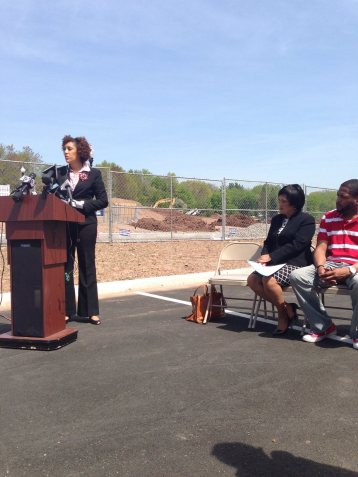
6 years ago today I stood at the border of the City of New Haven and the Town of Hamden in South Central CT and watched history unfold. After years of rancorous process, we had reached the moment and the unsightly wall that had existed between these two communities  for over 50 years would come down.

To understand the significance is to understand a long history of segregated housing, disinvestment in urban communities broadly and public housing specifically, suburban development, rising poverty, increased crime statistics, nascent and growing prejudices and biases associated with the placement of federally funded public housing communities in a remote area of New Haven on the town line with its mostly working class, suburban neighbors in Hamden.

The wall was built with support from government officials on both sides of the border at the time to literally keep the poor families on the New Haven side separated from the homeowners on the Hamden side.  New Haven took the lead reversing the errors of the past that lead to such disconnection and in building a sense of community and knitting together a community that spanned municipal lines.  Over the period from 2005 to 2014, Elm City Communities/Housing Authority of the City of New Haven undertook a massive effort to rebuild the affordable communities in the West Rock neighborhood of New Haven.  During that time Brookside and Rockview, Ribicoff Cottages (now Twin Brook Estates) and the Wilmont Crossing were completely redeveloped offering quality affordable and market rate rental and homeownership housing opportunities.

Throughout the redevelopment, rebuilding the housing and providing needed services to this isolated neighborhood was only one part of the community revitalization plan.  Another significant part of the plan included the re-connection of the street grid.  Ending the isolation of West Rock required creating a road connection between New Haven and Hamden through Wilmot Road and newly created streets providing needed access to transportation, shopping, jobs and amenities.  And for this, we sought to engage the leadership and residents of the Town of Hamden.

Willing Hamden Mayoral leadership in former Mayor Scott Jackson did not translate into widespread community support.  Those who were most vocal – although they represented a small proportion of the overall town population – were adamantly opposed to the removal of the fence and connection of the road.  Citing traffic concerns alongside veiled and blatant discriminatory statements, community meetings exploded into heated, aggressive outbursts that sought to derail our plans.

But we persisted.  Supported initially by the foresight of former New Haven Mayor John DeStefano, Jr. and carried forward by former Mayor Toni N. Harp, we engaged state and federal legislators and US Department of Housing and Urban Development as well as our top-notch legal team lead by Attorney Rolan Joni Young, to apply the right mix of leverage and legal interpretation that allowed us to move forward.  On on this day in May, 6 years ago, we gathered to celebrate the tearing down of the wall.

And what a celebration it was! But what is more monumental now looking back is the ability to reflect upon the fact that what we knew to be true was.  Communities are not built with walls and fences.  When we see a problem, we must resist the temptation to put up a wall to block people out or corral them in.  Communities are built when we create the conditions where people’s needs are met, where people can co-create a way forward together and where we respect  each other’s needs and perspectives.  Standing today at the border between West Rock and Hamden, I note a quiet, suburban feeling community with little traffic and people enjoying their homes.

In a local and federal context that too often sees fences, jersey barriers and walls as the solution to controlling people’s behavior, I take the lessons of our West Rock community to heart.  Let’s not build walls, let’s build communities.


For more information on the story of our West Rock community visit this story from the NY Times.   https://www.nytimes.com/2014/07/12/nyregion/in-connecticut-breaking-barrier-between-a-suburb-and-public-housing.html.


Karen DuBois-Walton, Ph.D. is the President of Elm City Communities/Housing Authority of the City of New Haven, CT.  Trained as a clinical psychologist, Dr. DuBois-Walton has led the agency since 2008 integrating progressive housing policy, community development and social service provision in ways that create communities of opportunity for low-income residents.  ECC/HANH’s vision is a New Haven where every resident has a safe and decent home that they can afford and opportunities to fulfill their goals.

Why I Believe…

Everyday as I walk through the halls of ECC/HANH I see our young interns at work in offices throughout the agency. These high school and college students bring an energy to the office.  In them, I see potential.  I see our future.  A bright future in which I am proud to invest. Our interns are all members of families who live in our affordable housing communities or subsidized housing.  They came with varied interests – IT, finance, social services, building trades and more.  Some just needed some income.  All wanted to be given a chance – a chance to earn and save some money; a chance to be cared for by adults willing to invest in them; a chance to see what it was like to work in this particular work environment; a chance.  Some were the types of kids that get selected for things everyday.  Others are youth that may get overlooked.  Each are a part of our ECC Believes initiative.

In 2014, at Elm City Communities/Housing Authority of the City of New Haven we launched the ECC Believes! initiative.  ECC Believes! represents our commitment to the young people growing up in our affordable communities or our subsidized units.  ECC Believes! represents an explicit expression of the faith that I have that when young people are offered opportunities to thrive, most will.  ECC Believes! is grounded in the belief that families want better for their children and will willingly partner with those who they trust have their children’s best interests at heart.  ECC Believes! is built upon the notion that we can break cycles of poverty by investing in children to ensure that they graduate high school “ready” for whatever comes next – college, military service or living wage employment.

ECC Believes! begins with our littlest residents by providing supports to families to ensure healthy births.  Our initiative supports families so that they have the information necessary and the means to access quality early child education.  We support academic achievement through the provision of in-school tutorial supports and after school academic and social emotional supports.  Our focus on attendance works to keep kids in school and help reconnect our disconnected students back to the educational system.  Our teens are supported with paid meaningful internships, work experience and mentorships.  Teens in each development have the opportunity to serve on Youth Leadership Councils as part of our leadership development work.  And importantly our teens are supported in their transition and retention to higher education, employment and more.

For 5 years we have made this intentional investment in our young people and I can certainly say, “I still believe”.  For 5 years we have seen families and young people take hold of opportunities presented to them.  Over five years, babies have been born to moms who took advantage of pre-natal supports, wellness checks and stress and depression management.  Over these five years, families have gleaned information and resources that result in toddlers enrolling in quality early child educational settings.  During these 5 years we have tutored students in their school settings and in their home communities by certified teachers.

We have 5 years worth of after-school community based academic and recreational programs serving young people throughout our developments.  We now have 5 years worth of experience employing our young people in paid internships.  During these 5 years we have helped young people who had been disconnected from high school, get re-engaged in school, pursue trades and obtain employment.  For 5 years we have supported hundreds of young people in their transition out of high school with most going on to college.  Enough time has passed that we have seen our students graduate college and attain their first job opportunities. For these past 5 years we have seen the benefits of investing in our young people and letting them know that we believe in them.

We have seen 75% of the youth engaged in our youth programming demonstrate grade level increases in reading and math scores.  We have seen school absenteeism reduced by half. Some of the first interns that worked with us have now graduated college.  And this month we identified our graduating high school seniors and celebrated the achievements of these 30 as they announced their plans to attend Gateway Community College, University of CT, Howard University and more.

The stories of our young people inspire me. And for these reasons and more, I still believe!

ECC Believes! is an initiative of Elm City Communities/Housing Authority of the City of New Haven to support youth achievement.  Begun in 2014, ECC Believes! partners with students, families, schools and community providers to support youth in and out of school. 


Forty-one percent

Forty-one percent.

Of the $93M worth of housing construction done by Elm City Communities/Housing Authority of the City of New Haven over the past decade, 41% of the construction dollars went to small, minority, women-owned and Section 3 designated local companies. That is over $37m dollars circulating through over 70 local contractors.

Part of ECC/HANH’s efforts in creating communities has been our work to redevelop our portfolio. Turning 80 year old properties into newly designed, vibrant, energy -efficient communities of choice is a major element of the work that we do. Over the past decade we have rebuilt over 2,000 units of quality affordable and mixed income housing in the City of New Haven. The creation of these units has changed the lives of thousands of people who are so deserving of this investment.

 
What can sometimes be missed are the related benefits of such a massive redevelopment effort. The economic benefit for the city cannot be overlooked. Analyzing the most recent major redevelopments that we have undertaken – Fair Haven, Farnam Courts/Mill River Crossing, Wilmot Crossing and Ribicoff Cottages/Twin Brook Estates a few things are of note.

 
These developments have generated almost $100 million dollars of investment at a 3:1 leverage ratio of private dollars to public dollars.

 
It is well known in affordable housing research, that for every 100 units of affordable housing created, 120 jobs are created. Further, long after the development phase, the creation of each affordable housing development supports continual employment for at least 30 on-going new related jobs. (http://plannersweb.com/2011/08/the-economic-fiscal-benefits-of-affordable-housing/). This has been borne out in the effects of ECC/HANH’s redevelopment efforts.

 
Each of our development projects is accompanied by our commitment to ensure the businesses that historically have been locked out of competition for the construction related contracts get their fair share of the work. This means focused attention on ensuring that minority-owned (MBE), women-owned (WBE) and Section 3 businesses (businesses owned by or that primarily employ low income residents of the area) are prioritized for contract opportunities. Based upon disparity studies, goals for our projects were established that targeted 30% for Section 3 businesses, 20% for MBEs and 6.9% for WBEs.

 
All too often when asking people or organizations to create more opportunity or make real steps toward diversity, equity and inclusion the response is “we tried but…”, “we can’t find people” or “the smaller contractors are unable to meet the requirements”. The results of our efforts are one demonstration that when effort aligns with strategy, diversity, equity and inclusion will be achieved.

 
Our redevelopment projects have met and exceeded the goals that we set forth. For some projects (e.g. Ribicoff Cottages/Twin Brook and Wilmont Crossing) more than half of the dollars spent went to MBE, WBE and Section 3 businesses. In sum, of the $93 million dollars invested across all projects, 40.38% or $37.7 m went to over 70 MBE, WBE and Section 3 businesses. To break this down, 30% of the dollars ($28.6M) went to MBEs, 14% ($13.4M) went to WBEs and 31% ($28.8M) went to Section 3 businesses.

 
Our city is made that much better by the fact that dollars that circulate through small, local businesses stay in the local community longer. Creating opportunity to those who’ve been left out is possible. It takes intention, will and strategy. It takes a willingness to think equitably and know that we all benefit when we create conditions of inclusiveness.

 
I am proud of the 2,000 beautiful units of affordable housing that we have built. I am proud of the families that call them home and use them as a platform from which they can strive to reach their goals. I am proud of the 74 local MBE, WBE and Section 3 businesses that participated in this process.

 
I am proud of the 41%.

 
Karen DuBois-Walton, Ph.D. is the President of ECC/HANH’s instrumentality, The Glendower Group, Inc., which is a non-profit affordable housing developer of mixed income communities. The Glendower Group has developed over 2,000 units of tax-credit, federally and state subsidized housing and market rate housing in the City of New Haven.


A tribute….

Communities are built of people.  People in relationships.  Recently I lost a friend.  A friend who was a central part of the community that I’ve built for myself and my family.  Her life was a testimony to the power of friendship and community.  Today I share the words that I shared at the funeral of my dear friend, Sheila Allen Bell who departed this life too soon on June 7, 2019.

Over the past 7 months I spent a good deal of time with Sheila in medical facilities. Each time I’d meet a new member of her care team, I’d be asked “are you family?”  A standard question in medical facilities designed in part to determine relationships so they’d know how much info should be shared. I’d say “no, just a good friend.” Sheila inevitably within a few minutes would introduce me to the very same caregiver and tell them that I was her sister.  In those moments having to say “friend” instead of “family” was hard. Partly because I knew that if I was seen as kin, I might be better able to advocate for her needs. But mostly, it was hard because saying friend felt inappropriate because she was more than that to me. Sheila was a friend who became family. 

Sheila has been a constant in my life for 20 years dating back to when she tried to recruit me to serve as her deputy at the City in the Community Services Administration.  As things would have it, rather than assuming that position, Mayor John DeStefano appointed me to the CAO position making Sheila and I colleagues.

Sheila made it her mission to make me welcome in this new strange, government setting. One day after sharing some moment of insanity in city hall, she leaned over to me and in a conspiratorial whisper asked me “how are we going to make it here?” As I think about that question – how are we going to make it here- I realize that in that question Sheila was previewing for this new, very-green city employee that there were going to be many land mines ahead and that strategy was going to be essential. More than that though it was a hopeful, optimistic question because it presumed that whatever was to come we were going to make it. And finally and most importantly, it was a joining question- it’s a question that explicitly stated that “we” – not me and not her – but that we would make it. 

We continued that discussion at her house – in Harbour Landing at that time- over a meal she fixed and honestly with too many apple martinis which was her drink at the time. Who here can’t relate to that?

And so our friendship and sisterhood began. We worked together for many years. We ran up and down the highways together. After working all day, we’d travel home in separate cars on the phone with each other. Many a night Kevin would come home to find me on the phone with her and he’d ask “didn’t you just leave Sheila”. And of course I had and yet there was so much still we had to say.

This sense of us making it became a theme. That initial question became our code which she shortened to “what we gone do?”  And we asked often, what we gone do? When it was time to leave city hall, what we gone do? When we went to the Housing Authority- what we gone do? When we faced a work issue – what we gone do? When local politics heated up- – what we gone do?  When personal trouble came – what we gone do? When Trump was elected – what we gone do? When illness came, what we gone do? In so many moments of big or little decision making, we asked – what we gone do? 

And for as much time as she gave me, I know that so many of you gathered here today share similar memories of Sheila – your “we” memories. Memories that made you think of her as a friend who was family. 

Whether you saw her daily, weekly, quarterly or annually, Sheila provided that for so many.  She once told me that a male friend of hers had told her that he realized early on that if you wanted to be friends with Sheila that you’ve got to learn to share.  How true this was. Sheila was the type of person whose giving nature made everyone she encountered feel like they alone had that special relationship with her. And they did. Because each person that Sheila loved, was loved in a unique way and held a unique space in her life.  

Perhaps you connected around church, work or sorority.  Maybe you were on a board or in an organization with her. Maybe you shared a love of good food, drink, plays and jazz.  Maybe you loved birds. Maybe you were a displaced Southerner who found yourself up north. Maybe you were her neighbor. Maybe you nursed or held political office.  Maybe she worked for you, with you or you worked for her. Maybe you shared books and movies, salmon and broccoli. Maybe you loved Bridgeport like she did. Perhaps you attended concerts on the Green with her.  Maybe you ate at Sage or Mickey’s. Maybe you loved photography or facials and massages. 

Something connected you to Sheila and from that thread she built a relationship with you and she held that relationship special with you. And in her magical way one relationship never lessened any other relationship.  In fact, Sheila used these ties to create new communities. Through Sheila, people connected who may never have met. And then her friends became part of your circle. Sheila expanded the circle of friendship. Sheila built family out of her network of friends. And in that way she expanded all of our families. Sheila was a friend who was family. This was part of her gift.  

Now don’t get me wrong, nothing was more important to Sheila than family. She was so proud to be a Stringer and an Allen. She loved that “Allen” name so much that she gave it to her only son. Over the years  I learned a lot about her family legacy and her roots in Charlotte. And in caring for her I finally had the opportunity to get to know those I’d heard so much about over the years, most especially her nephews George and Dwayne, their wives Jessica and Tisha, and her beloved great nephew- Jelani- who was the light of her life.  And so seeing how she treasures family, it was even more special to be friends with Sheila because Sheila treats friends like family. 

I stand here today as one representative of the hundreds who call her friend. I am forever grateful to the circle who helped support Sheila here during her time of illness.  I couldn’t have done nearly as much without Hilda, Shenae, Syd, Elna, Claudette, Cousin Lynn, Paulette, Wendy, Rolan, Lorraine, her caregivers at the Hospital of St. Raphael, Regency House, MidState Hospital and Constellation Hospice and so many more.

But now too soon, I find myself having to navigate the question that formed the basis of our friendship- how are we going to make it- or colloquially- what we gone do- for the first time without my friend, my friend who’s like family.

And so here we are, the set of individuals who through Sheila – became friends- and became part of an extended family and became a “we”.  I ask Sheila’s question of us all. Of this assembled “we”. So what we gone do? 

In honor of the very best that Sheila had to offer, I suggest that this is what we gone do…

(What we gone do?)

We gone…

  • Enjoy life fully, with laughter and love, with good friends, good food and yes, good libations
  • Treasure music, art, photography, theater and birds
  • Every now and then find an open stretch of highway and fly down the road like Sheila did in Bell88
  • Hit up Lord and Taylor’s and the Coach outlet
  • Enlarge our circles, welcome new colleagues, and mentor others knowing that our light won’t dim by lighting another’s
  • We are going to shed mother, sister, auntie love on those in our circle who need it
  • Get a facial, listen to Ray Charles and watch the Haves and Have Nots
  • Join a board of an organization that you care about, serve on that board and when they have a fundraiser mercilessly push ticket sales on every person you know, like Sheila would 
  • Speak your truth, mend fences, practice forgiveness
  • Be faithful, trust your God and love your neighbors
  • Make friends, share your love, broaden your circle and surround yourself with special people

And if we do this, if we live a bit like our friend did, we too will find that when we look back and survey our circle it’s filled with friends who like Sheila were family. 

Rest well my friend. I’ll see you again.

Sheila Allen Bell (b. August 8, 1950 d. June 7, 2019) served as the Assistant Executive Director at Elm City Communities/Housing Authority of the City of New Haven prior to her retirement.  Sheila had a long history of public and private service dedicated to creating communities that work for our most vulnerable residents.  She was a loving mother, auntie, cousin, sister and friend.  She is missed greatly.


On sacred ground…

In Old San Juan we stood on sacred ground.

Most were focused on the history of Casa Blanca as the home of Ponce de Leon.

I was transfixed by this hole in the floor. Note it. Feel it. This is where enslaved Africans were chained so that they couldn’t escape.

This is sacred ground. My ancestors lived. Endured. Suffered. Breathed. Suffocated. Cried. Wept. Loved. Lost. In this hole.

While wealthy European colonizers lived, laughed, slept, ate….right above them.

Feel this. Don’t look away.

This is sacred ground. And it has nothing to do with Ponce de Leon.

Creating Communities that Thrive… On Re-entry

Creating Communities That Thrive… reflections on leading a housing organization


On re-entry

Karen DuBois-Walton, Ph.D.


I recently had the opportunity to sit within a circle of women who were discussing the challenges of their re-entry after a period of incarceration.  I was moved beyond measure by their honesty, their accountability and their insights into systems and situations that had led to their incarceration and their reflections on the system of mass incarceration and the challenges of re-entry.  In honest conversations, these women spoke of the economic challenges and personal and interpersonal situations that led them to commit a criminal act.  They spoke of services that they wish had existed at earlier points in their lives that may have addressed their need for education, job skills, employment, self-esteem and relationship skills that may have changed their trajectory.  They longed for diversion programs that may have offered options for restorative justice, treatment for behavioral health issues and parenting programs.  They offered thoughts on alternatives for parents who are convicted – alternatives that lessen the impact and trauma experienced by their children as a result of the separation.  They spoke of what they wished the incarceration system had offered in terms of healthcare, treatment and wellness programs, education, job training and more that would actually serve to rehabilitate souls and prepare them for re-entry.  And together we dreamed of a re-entry system that offered services, basic needs, employment, changed attitudes and forgiveness for those who had served their time.

These conversations are important as re-entry touches all of our communities.  As many of 100 million US adults – nearly one-third of the population- has a criminal record of some sort according to the US Department of Justice’s Bureau of Justice Statistics[1].  The majority of these records are misdemeanor crimes not felonies. The New England states represent 5.3 million of these adults.  Our mid-sized cities are home to a disproportionate number of returning adults.  While CT specific statistics have been difficult to gather, it is known that New Haven welcomes home over 100 returning citizens each month who have completed their sentence or are on probation or parole[2].

New Haven was the first CT city to create a re-entry office within City Hall to specifically focus on the needs of this population.  Early on lack of housing was identified as an important barrier to successful re-entry.  Beginning in 2009, Elm City Communities/Housing Authority of the City of New Haven (ECC/HANH) began partnering with the City’s re-entry office to create housing opportunities specifically aimed at this population. Our initiative has grown over the years and remains rooted in the fundamental beliefs that “we are not our worst moments” and “everyone deserves opportunities”.  Believing in both of these tenets, we have offered opportunities to house hundreds of returning citizens through initiatives that offer opportunities without sacrificing the security of our developments.

Long before the federal government offered guidance to housing professionals on the Fair Housing implications of the use of criminal background records in selecting residents[3], ECC/HANH had adopted revised screening protocols that removed the conviction history from becoming a barrier to accessing housing services.  Beginning in 2009, ECC/HANH introduced pathways to housing that allowed returning individuals to be added to the lease of an existing household or access their own unit or voucher through specific set-aside waitlists for returning residents.  Individuals housed through these pathways undergo a revised screening that does not deny them upon discovery of a criminal conviction.  Instead, returning individuals apply through a process whereby they are able to provide evidence of their rehabilitation through attestations of a probation or parole officer, recommendation of employers or treatment providers and statements made on their behalf by individuals who could provide evidence of successful re-entry.

Rather than receiving a denial upon application, returning individuals are offered an opportunity to account for what had occurred in their past by offering testimony to what they had done subsequently and are currently doing to make a new start.  In other words, they are offered an opportunity to be more than their worst moments.  Through our revised criteria we are able to consider individuals with most any type of conviction excluding those that HUD requires we deny[4] and arson which we have chosen to deny.

By allowing individuals to join or re-join an existing lease we provide the most access to returning individuals.  This conceptually provides access to over 6,000 units of housing[5] because any of our assisted families could request to add a family member to their lease.  Individuals with a re-entry background are subject to our revised screening criteria which disregards most convictions (not the HUD mandatory nor arson) when the applicant can supply mitigating information such as positive employment history, verification from probation or parole, community service providers, treatment providers etc.

Additionally, beginning in 2009 we set aside a number of units within our portfolio that are specifically for the returning population.  We assess this number annually seeking to grow our ability to set aside units.  ECC/HANH partners with the City’s Fresh Start and Warren Kimbro Re-entry Programs (WRKP).  These partner entities screen and prioritize families for our waitlist.  We then house them according to that priority level and our availability of housing units or vouchers.  Again, all families housed through this manner are subject to our relaxed screening criteria.  They receive housing and supportive services.  When they no longer need services they “graduate”, however, they keep their housing.  Their graduation opens a space for a new family to be housed through our re-entry program.  We expanded our ability to house residents by offering access to a set-aside number of housing choice vouchers.  These vouchers are also issued in partnership with city entities including WKRP and Project Longevity[6].

We have experienced great success in housing individuals and families through these initiatives as measured by lease compliance, improved employment rates and household income, and low recidivism and eviction rates.  We attribute the success to these hallmarks of our program:

  • Relaxed screening criteria so that people are not ruled out due to their criminal background
  • No automatic denials (except for a few crimes that we are required to deny); instead everyone is given the opportunity to explain their situation
  • Ability to join the lease of an existing household
  • Dedicated units and set aside preferential waitlists for our units and vouchers
  • Supportive services provided for all our families
  • Partnerships with others who prioritize individuals on the waitlist and seek to house the most in need first


Finally, there are families who simply move their way through our waitlist process without the assistance of the re-entry program providers.  For families that include an individual with a reentry background, we offer assistance here as well.  In seeking to ensure that criminal background does not become a barrier to accessing our housing services, we have implemented a system where applicants called off one of our regular waitlists are notified as they reach the top of the waitlist.  If upon background screening a conviction is revealed that falls within our “additional review period” (now a 3 to 5 year lookback for most things), they are sent a notice for additional review.  Applicants may come in with or without an advocate for a review meeting.  We consider the same mitigating factors that we use for our re-entry programs during this review.  Applicants who successfully satisfy our review criteria move forward in the application process.  Applicants who do not are then sent a letter of intent to deny.  Applicants may disagree with that decision and afford themselves of the grievance procedure.  Through this revised screening process many individuals whose conviction history is older than 5 years are never subjected to further screening and those with more recent histories can take advantage of the opportunity to explain their circumstances rather than receive an automatic denial for housing services.

While the average recidivism rate over 5 years in CT has hovered around 50 percent[7], ECC/HANH has shown much more optimistic results with our re-entry housing population.  66% of our returning residents are employed and have maintained their employment for more than 6 months.  Each year between 33% and 50% have met all goals and graduate from the supportive services component of the program.  To date, less than 10% have reoffended and left the program- a percentage significantly lower than the statewide average 5 year recidivism rate.

While ECC/HANH was ahead of most other CT housing providers in adopting these measures, it is surprising that more have not adopted our best practices.  Given our track record of success with this population and more recent Federal guidance under the Obama Administration which has made clear the Fair Housing implications of relying on criminal background records to deny housing, all CT housing providers should be significantly revising their approach to background screening.  Federal guidance outlines how the reliance on criminal history has a discriminatory and disparate impact effect on protected classes and may well represent a Fair Housing violation.  Housing providers are well advised to look at their screening and admission policies to ensure alignment with the federal guidance.

CT policy makers have an opportunity to use their role to ensure that policies are updated.  Many housing providers look to CT CHFA and Department of Housing for needed develop and operating resources for their affordable housing portfolio.  CHFA and DOH should revise their funding awards to require compliance with Federal guidance on Fair Housing as it relates to criminal background screening.  Funding awards should not be made to developers and operators who fail to meet this standard.

Further, needed housing resource needs to be devoted to providing housing opportunities for the re-entry population.  All the efforts that ECC/HANH have made have been within its already too limited allocation of affordable housing resources.  CT and Federal policy makers must be called upon to adequately invest in basic needs resources of affordable housing and to ensure that within that allocation the Fair Housing implications of housing the re-entry population are met.

And finally as a community, we must all counter the myth that housing cannot be obtained if you have a criminal background.  This can be accomplished by sharing accurate information re. those housing providers like ECC/HANH who have already made needed changes and by pressuring other housing managers who have not yet complied to address the discriminatory processes that they employ.  We should do this as a community because it is the law, and it is the right and moral thing to do.  We must all continue to recognize the humanity in others knowing that none of us are our worst moments and all of us deserve opportunities to thrive.

I thank these brave women who shared such personal aspects of their stories.  They reinforced my belief that we are doing the right work at ECC/HANH and challenged me to find ways to serve more and more returning families.  They sparked powerful ideas for systems change that might realign investments into greater resource for efforts like ours to build communities that support healthy development; that reform our incarceration system into a system that actually rehabilitates; and that create environments into which people can return and be accepted without forever wearing a label created by actions conducted in their worst moment.


Karen DuBois-Walton is the Executive Director/President of the Elm City Communities/Housing Authority of the City of New Haven, CT. Trained as a clinical psychologist, Dr. DuBois-Walton has led the agency since 2008 integrating progressive housing policy, community development and social service provision in ways that create communities of opportunity for low-income residents in the City of New Haven. ECC/HANH’s vision is a New Haven where every resident has a safe and decent home that they can afford and opportunities to fulfill their goals.

[1] https://www.ncjrs.gov/pdffiles1/bjs/grants/244563.pdf

[2] http://www.phillytrib.com/news/new-haven-program-guides-those-released-from-prison/article_be648112-cd5f-53b6-8a40-d4f2b9d2790d.html

[3] US HUD Office of General Counsel Guidance on Application of Fair Housing Act Standards to the Use of Criminal Records by Providers of Housing and Real Estate-Related Transactions, April 4, 2016.

[4] HUD mandatory denials include anyone placed on the sex offender registry and those convicted of manufacturing methamphetamines on public housing property.

[5] This includes over 2,000 public housing units and over 4,000 Housing Choice Vouchers.

[6] Project Longevity is a federal, state and local partnership that seeks to intervene with individuals engaged in gang violence through a message of policing and supportive services.

[7] “The Criminal Population in New England: Records, Convictions, and Barriers to Employment.” New England Public Policy Center, Federal Reserve Bank of Boston, March 2017.

Welcome to Creating Communities That Thrive…

Many have cited the affordable housing crisis in this country.  Recently the New York Times highlighted the issue in its article “As Affordable Housing Crisis Grows, HUD Sits on the Sidelines”.  Local affordable housing providers don’t have the luxury of sitting this one out.  Everyday we are faced with the challenges of providing safe communities of choice to thousands of families while balancing the reality that many more go unserved.  Local providers have gotten very creative in meeting these needs.

Here at Elm City Communities/Housing Authority of the City of New Haven, we have used the flexibility granted to us by US HUD under the Moving to Work[1] program to implement a number of initiatives that increase housing choice for low income families, assist them in moving toward self-sufficiency and use limited federal dollars more cost effectively.

In this series of blogs, we seek to highlight the efforts of ECC/HANH as we live into our vision of a New Haven where every resident has a safe and decent home that they can afford and opportunities to fulfill their goals.  Beyond that we hope to explore broader solutions to the crisis of affordable housing.

The solutions to the affordable housing crisis are complex.  They involve the production of housing units and the access to subsidy dollars.  Solutions are tied to economic efforts that increase the economic standing of families in our communities.  Solutions will challenge local zoning and land use policies.  Addressing this issue will challenge biases held about those who live in poverty.  It requires an honest look at the historical and present day underpinnings and a commitment to living into equity.

At ECC/HANH we have tried some things.  Things that have improved the quality of housing provided.  Efforts that have replaced distressed housing with state-of-the art mixed income communities.  We have invested in people – from our youngest residents to our most senior.  And we have been innovative in seeking to stretch limited public dollars and use them to leverage private investment in our families and our communities.

But there is much to still be done.  Our waitlists are an inadequate indicator of the need.  The disparity between the wealthy and the poor has never been greater.  The City of New Haven is wrestling with how to meet the need for affordable housing while also building and maintaining the middle class.  CT as a state is challenged by segregated housing patterns and resistance to efforts correct this.  The state is in the midst of a fiscal challenge that promises to undermine efforts to do more for affordable housing.  And as a nation, as the NY Times article references, too little is being done at the federal level.

Join in this blog conversation as we explore a way forward to a place where every resident has a safe and decent place that they can afford and opportunities to fulfill their goals.

Karen DuBois-Walton, Ph.D. is the Executive Director/President of the Elm City Communities/Housing Authority of the City of New Haven, CT.  Trained as a Clinical Psychologist, Dr. DuBois-Walton has led the agency since 2008 integrating progressive housing policy, community development and social service provision in ways that create communities of opportunity for low-income residents in the City of New Haven.  ECC/HANH’s vision is a New Haven where every resident has a safe and decent home that they can afford and opportunities to fulfill their goals.

[1] Moving to Work is a demonstration program of the US Department of Housing and Urban Development that offers flexibility to local housing authorities to develop local solutions that increase housing choice for low income families, increase family self sufficiency and offer cost effective solutions.  ECC/HANH has been a MTW agency since 2000.